
The Beauty of CAGR - How it can help investors to choose right investments
In the world of investing, numbers often feel cold and intimidating. Yet behind these numbers lies a concept so elegant that it quietly shapes long-term wealth creation—the Compounded Annual Growth Rate (CAGR).
CAGR is not just a formula. It is a lens. A lens that helps investors see clearly through noise, volatility, and exaggerated promises.
Why simplicity feels like beauty?
CAGR looks deceptively simple:

Yet within this simplicity lies a powerful philosophy.
CAGR smoothens chaos. Markets jump, fall, stagnate, and surprise—but CAGR tells you the final truth of the journey.
For retirement planning, this clarity is priceless. Many people see a retirement corpus number and feel overwhelmed, like staring at a mountain peak from base camp. CAGR turns that mountain into a long staircase—one step at a time. Once you know the step height (CAGR), the mountain may stop looking impossible.
Let’s see this in action with three brothers who all end up rich on paper—but not in the same way.
A simple story: Amar, Akbar, and Anthony
Three brothers invested ₹1,00,000 each in real estate.
After 10 years, all three ended up with ₹4,00,000.
Same absolute return. Different journeys.
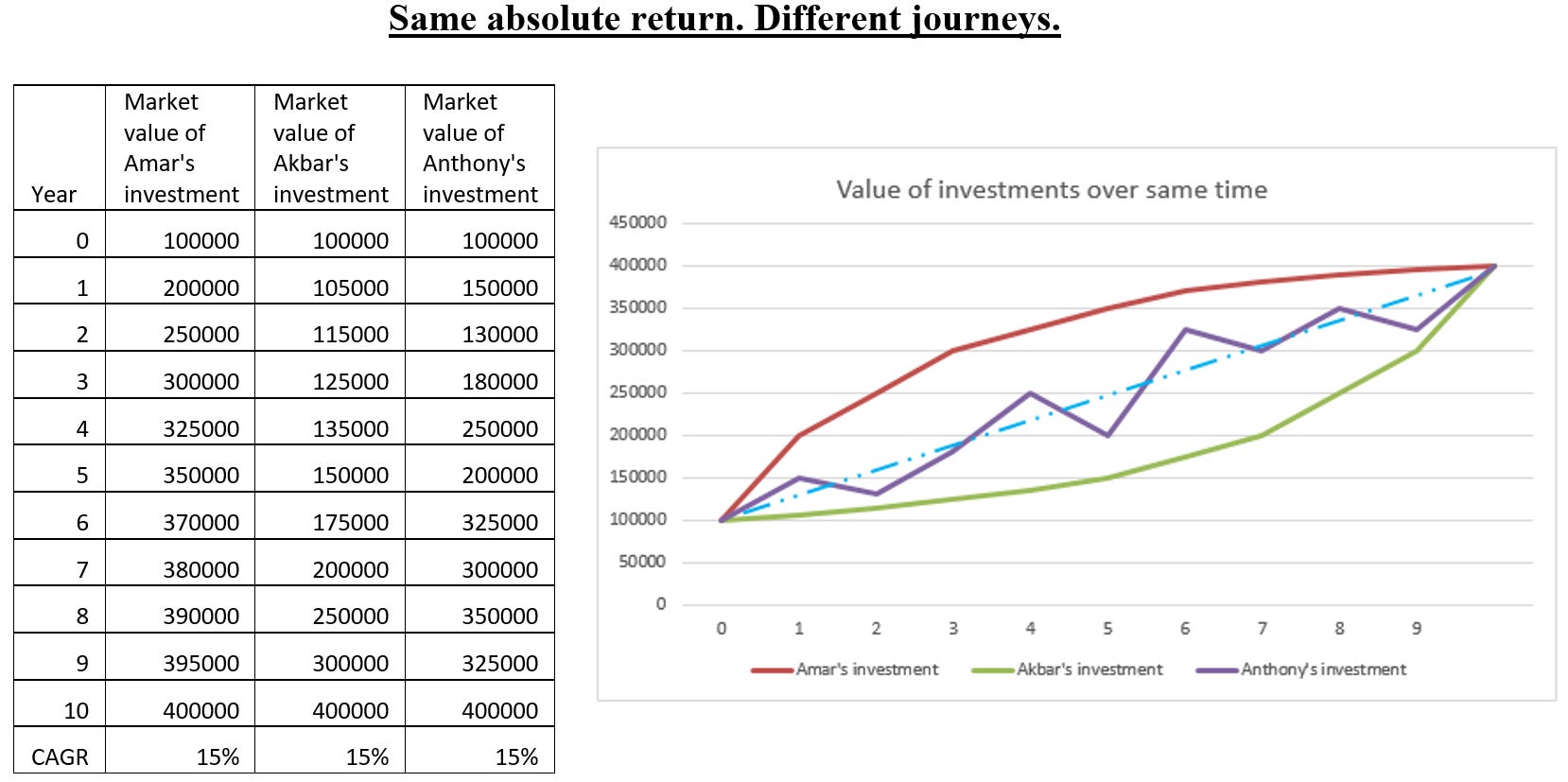
On paper, all three ‘quadrupled’ their money, but their experiences were completely different. One faced sharp jumps, One slow growth, and One wild swings. CAGR helps answer the real question:
Who truly grew their money better over time?
Another story: Amar, Akbar, and Anthony
Suppose they invested ₹1,00,000 each in real estate, and sold their properties at different times.
Different absolute return. Same rate of return.
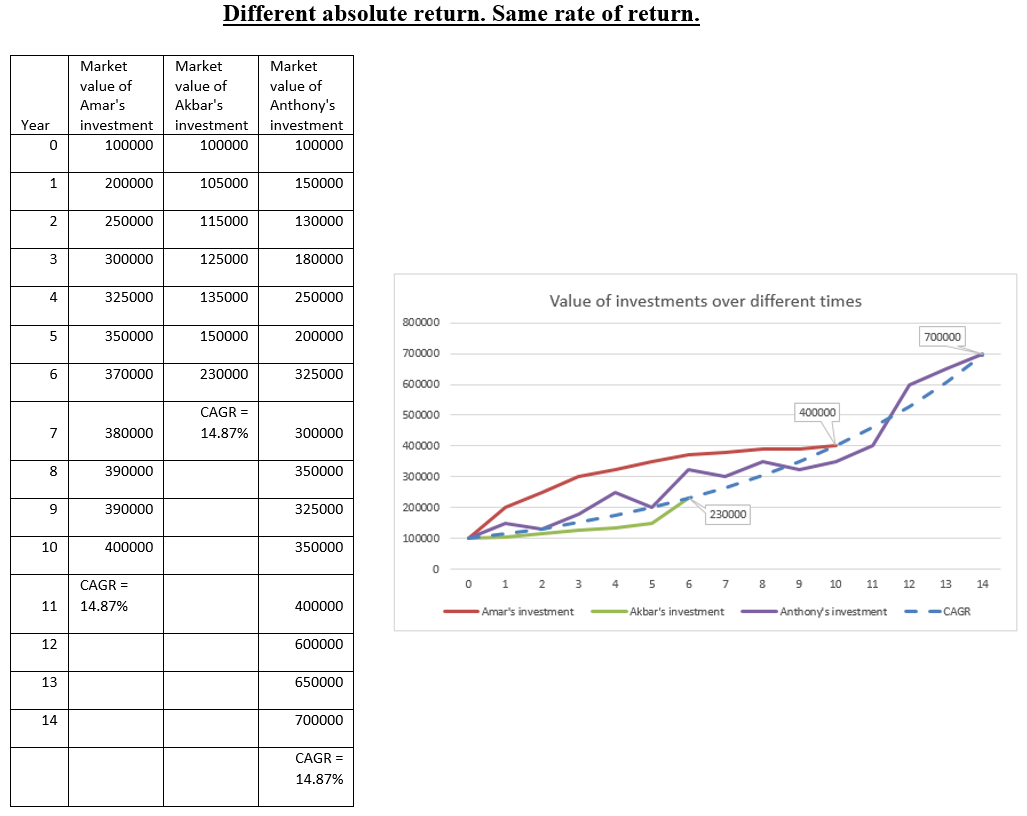
Anthony got maximum benefit in absolute terms. but his rate of return was same as Amar’s and Akbar’s rate of return.
Where CAGR protects investors
1) Assessing investment in Real Estate vs. Financial Instruments
Real estate feels tangible, but CAGR quantifies if it’s better than stocks or gold ETFs.
Scenario: A property bought for ₹50 lakh in 2016 sells for ₹1 crore in 2026 (CAGR ≈ 7.2%, before maintenance costs). Meanwhile, a gold ETF over the same period might have a 17% CAGR, but an equity index fund hits 14%. This shows real estate’s lower liquidity and costs might make financial products more efficient.
Following are two different illustrations of how ULIPs can mislead. Many investors in India meet this pitch at least once in their lifetime.
2) ULIP Case 1: Single maturity payout
An investor is shown an illustration saying: “Invest ₹1 lakh per year for 15 years and Get ₹30 lakh at maturity”. Sounds attractive.
How CAGR helps? By calculating CAGR, the investor may discover the actual return is only 8%.
3) ULIP Case 2: Maturity plus income stream
An investor is shown an illustration saying: “Invest ₹1 lakh per year for 15 years and Get ₹3 lakh every year from 15th year onwards till 30th year”. Sounds attractive.
How CAGR helps? By calculating CAGR, the investor may discover the actual return is only 7.8%.
CAGR exposes the true return hidden behind glossy projections.
4) Gold vs Equity for Long-Term Goals
Investor is confused when comparing gold vs small cap mutual fund for lumpsum investment.
Let’s look at past 15-year data:
Gold CAGR: ~14%
Average small cap MF CAGR: ~17%
How CAGR helps?
Instead of emotional bias, CAGR offers objective clarity on long-term wealth creation.
CAGR supports while planning goal-based investments like retirement, child’s higher education etc.
5) Selecting a Pension or Retirement Product
Multiple retirement products promise “stable income” or “capital protection”.
CAGR helps evaluate actual growth rate during accumulation phase and whether it beats inflation. If a product grows at 5% when inflation is 6%, purchasing power is actually shrinking.
The great equalizer
By now, CAGR has quietly appeared across real estate, ULIPs, gold, equity, and pensions. And, CAGR allows apples-to-oranges comparison:
Equity vs debt
Mutual funds vs real estate
Gold vs business income
Even personal savings growth
It doesn’t predict the future. But it prevents self-deception.
In conclusion
The beauty of CAGR lies in its honesty. It doesn’t make decisions for you—but it makes sure you see them clearly.
Just like habits compound into character, small investments compound into financial security. Not through brilliance. But through consistency.


Comments
Post a Comment